
OEM vs ODM for a Department Store Launch: Where Quality Control Sits
Choosing between an OEM and an ODM route for a department store launch is really a decision about where quality control sits, not about which route cares more about quality. On an OEM route the brand keeps the formula, the specification and the batch release, and therefore carries more of the checking work. On an ODM route the partner develops the scent and absorbs more of the routine testing, which shortens the path to launch while moving the evidence trail further from the brand. The right choice follows the launch calendar and the size of the internal quality team, and either route can be run well or badly.
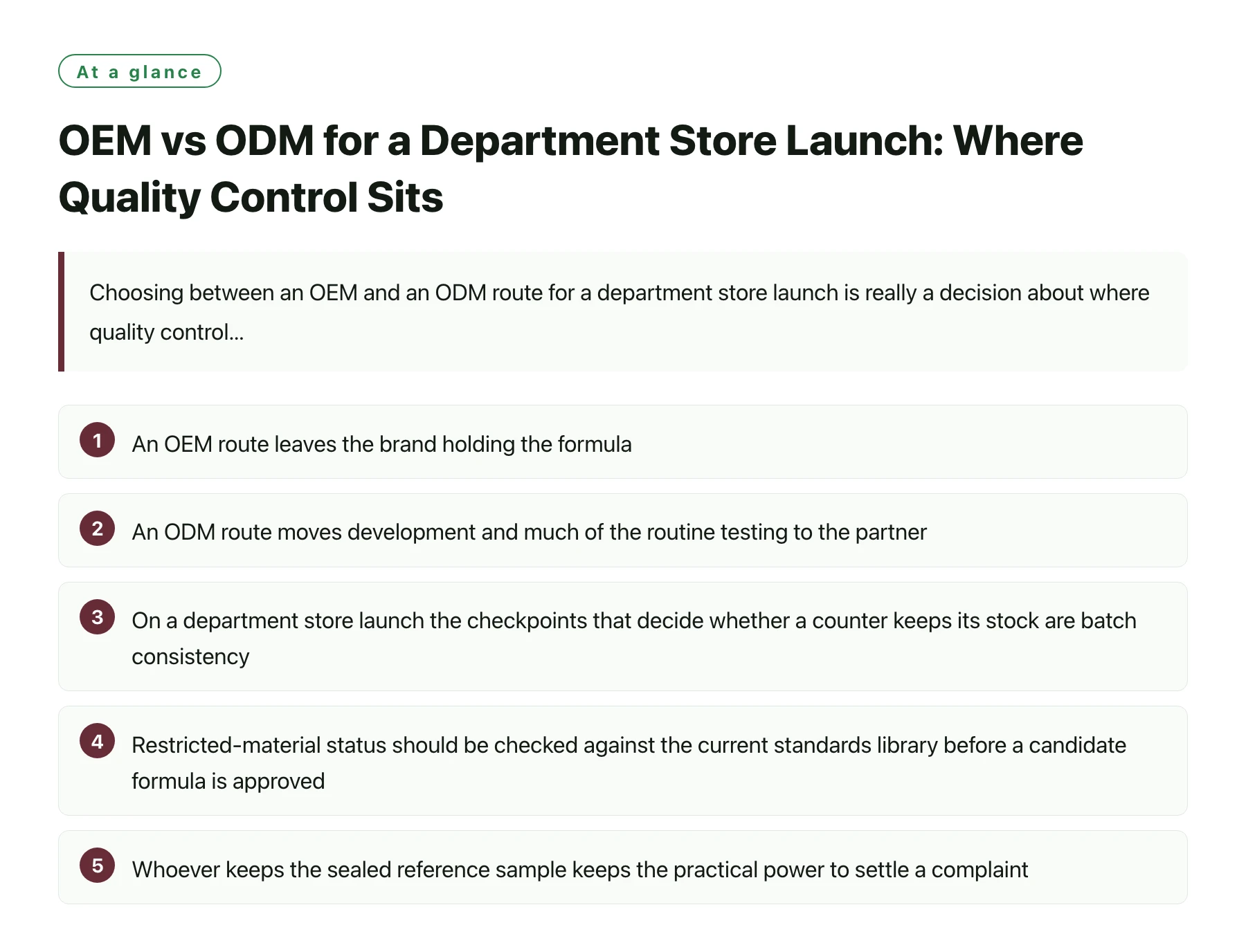
Key takeaways
- An OEM route leaves the brand holding the formula, the specification and the batch release, so it suits a team that can review records and keep its own reference samples.
- An ODM route moves development and much of the routine testing to the partner, which usually shortens the development calendar but should be exchanged for a clear audit right.
- On a department store launch the checkpoints that decide whether a counter keeps its stock are batch consistency, fill and actuation performance, label and ingredient declaration accuracy, and outer packaging integrity.
- Restricted-material status should be checked against the current standards library before a candidate formula is approved, because a composition can be beautiful and still need reformulating for a given product category [2].
- Whoever keeps the sealed reference sample keeps the practical power to settle a complaint, so the retention arrangement belongs in the contract rather than in a verbal understanding.
- Both routes need a named corrective-action process, because at retail the speed of a hold or recall decision matters more than the wording of a quality policy.
A department store launch compresses the whole quality question into a single date. The retail buyer wants the counter stocked, the tester on the shelf and the line sheet finalised, and none of that leaves room for discovering a fill problem or a smudged ingredient declaration three weeks before opening. The quality manager's job in that window is not to run the factory better; it is to be certain about which parts of the process the brand still controls and which parts it has handed over.
OEM and ODM are often described as two ways of buying the same thing, one with more development included. The distinction is more useful when it is read as a description of where the controls sit. On an OEM route the brand brings or specifies the fragrance and the factory compounds and fills to that specification. On an ODM route the factory proposes and develops the scent, then manufactures it. Everything downstream of that difference, from who writes the specification to who tests, who releases and who holds the retained sample, follows from it.
The checkpoints below are set side by side, written from the position of a quality manager preparing a department store launch. That setting is unforgiving in a specific way: a single inconsistent batch is visible to shoppers and to a retail buyer at the same time, and the correction happens in public.
Quality control checkpoints on each route
| Checkpoint | What an OEM route leaves with you | What an ODM route moves to the partner |
|---|---|---|
| Formula and specification control | The brand supplies or approves the formula and owns the specification sheet, so every deviation is a supplier non-conformance the brand has to detect. | The partner develops the formula and presents it for approval, and the brand signs off a reference rather than a full document set. |
| Raw material and component approval | The brand approves or audits the supplier list, which makes it the brand's job to notice a substitution before it reaches production. | The partner's approved supplier list governs, and the brand usually sees a material declaration rather than the sourcing decision behind it. |
| Batch consistency and reference retention | The brand defines the tolerance band and should hold a duplicate sealed reference drawn from the approved batch. | The partner keeps the reference and reports conformance, so the brand should still ask for its own retained sample. |
| Fill, actuation and mechanical checks | Fill volume, spray performance and leak testing are written into the brand's specification, and the brand reads the test records against it. | The partner applies its internal standard, and the brand's practical check is a comparison against the approved golden sample. |
| Testing scope and third-party work | The brand decides the test matrix for every pack combination and commissions the work, including independent laboratory testing where the retail customer expects it [1]. | The partner runs stability and compatibility work on its own bases and shares results, but that scope may not cover every retail format the brand intends to sell. |
| Label, ingredient declaration and artwork | The brand owns the legal text and approves every print run, and the factory prints to that approved artwork. | The partner may prepare the declaration from the formula, but the brand still carries the responsibility for what the label says. |
| Batch release and corrective action | The brand issues the release and can hold or reject a batch, which is real leverage and also a real workload. | The partner releases the batch, and the brand's leverage sits in the audit right, the complaint process and the remedy terms. |
Read across the rows and the pattern is simple: the OEM route buys control at the cost of workload, and the ODM route buys speed at the cost of visibility. That is why the decision belongs with the launch date and the team behind it rather than with the unit price alone, and why it is worth seeing how Xuelei's factory splits those checkpoints between the two routes before either model is fixed.
Sign-off authority and how a defect surfaces
The two routes fail differently, and the difference is easier to see in the release decision than in any quality manual. A department store launch does not care which party holds the release; it cares how quickly a problem is caught and how clearly responsibility is assigned when it is.
Where the brand keeps sign-off authority
Sign-off is the checkpoint that most often gets blurred when development is bought as part of the package. On an OEM route the brand's quality team approves the specification, approves the reference, approves the artwork and releases the batch, while the factory executes. That sequence is slower, and it is also the reason a problem is usually caught before the goods leave the building, because someone outside the manufacturing team is looking at the evidence.
On an ODM route the partner typically releases the batch against its own internal standard, and the brand's approval sits earlier, at the reference and the specification. That is not a weaker arrangement, but it is a different one: the brand is trusting a control system rather than inspecting an output. Before signing, three things are worth settling in writing, namely the audit right, the duty to notify when a non-conformance is found, and the remedy if a batch reaches a department store counter and fails there. Xuelei sets out how those controls are usually structured in a fine fragrance environment, and factories such as Xuelei publish a comparable certification set, including ISO 22716, GMPC, ISO 9001, ISO 14001, ISO 45001 and HALAL conformity, which is a starting point for that conversation rather than the end of it.
How a defect surfaces differently on each route
Where the brand writes the specification, a defect usually appears as a documented non-conformance: a fill weight outside range, a leak in the transit test, or a declaration that does not match the artwork the brand supplied. The brand sees it because the brand asked for the record and knows what the record should contain.
Where the partner owns the specification, a defect is more likely to surface as a commercial event than as a document. A counter reports that the tester smells flatter than the approved sample, or a retailer's own laboratory finds something the brand never tested for. Retailers and their customers increasingly expect a documented supply chain behind a product, and the trade press tracks that shift closely [3]. That is why the ODM route needs a more explicit pre-launch conversation about which complaints the partner treats as its own and how quickly it will investigate, because both routes end in the same place if the answer is vague: a brand arguing about a defect it cannot independently verify.
If the launch date is fixed and the internal quality team is small, an ODM route is often the more honest choice, provided the brand negotiates the audit right, the retention sample and the notification duty before the first purchase order. The mistake to avoid is choosing an OEM route for control the brand does not have the staff to exercise, because a specification nobody reviews is not a control at all, it is a document. A partner that welcomes a walkthrough and answers questions about batch records is the one worth keeping, whether it sits on the OEM side or works as an ODM partner for fragrance brands.
Sources
- SGS: Cosmetics, Personal Care & Household Testing —— Testing, inspection and certification services for cosmetics and personal care, including microbiological, stability and safety testing aligned with cosmetics GMP.
- IFRA Standards Library (International Fragrance Association) —— The IFRA Standards Library lists the restrictions the fragrance industry applies to individual fragrance ingredients, based on safety assessments; it is the reference point for compliant fragrance formulation.
- Cosmetics Business —— A trade publication covering the beauty and cosmetics industry, including fragrance launches and regulatory developments.
Frequently asked questions
Does an ODM route mean the brand gives up control over quality?
Not control itself, but much of the routine checking. The brand keeps approval of the reference and the specification and usually keeps an audit right, while the partner runs batch testing and release. What changes is where the evidence sits, which is why an ODM agreement needs a firmer notification and remedy clause than an OEM one.
Which checkpoints matter most before a department store launch?
Batch consistency against a sealed reference, fill and actuation performance, label and ingredient declaration accuracy, and outer packaging integrity in transit. These are the four a shopper or a retail buyer can detect within minutes, and each one is cheap to verify before shipping and expensive to correct once the counter is stocked.
Who should keep the reference sample?
Both parties, ideally. The factory's retained reference is what it compares production against, while the brand's duplicate is what it can turn to if the relationship ends or a dispute arises. A sealed, dated reference drawn from the approved batch is the single most useful quality document a brand can hold.
Is an OEM route always slower than an ODM route?
Usually, because the brand has more decisions to make and more documents to approve. The gap narrows when the brand already owns a formula and a specification, and it widens when the brand needs development work and still wants to review every test record. The honest comparison is against the time the internal team can actually spend.
What should a quality manager ask for in the first meeting with a factory?
The specification format, a sample batch record, the retention policy, the scope of stability testing, and the corrective-action process with its timelines. Asking for documents rather than assurances is the fastest way to learn how a factory operates, and it works on both the OEM and the ODM side.
One weekly email. Zero filler.
The best Cinema 4D tutorials, scene files, and studio jobs — vetted by working artists, delivered every Monday.
Join 47,000 C4D artists